
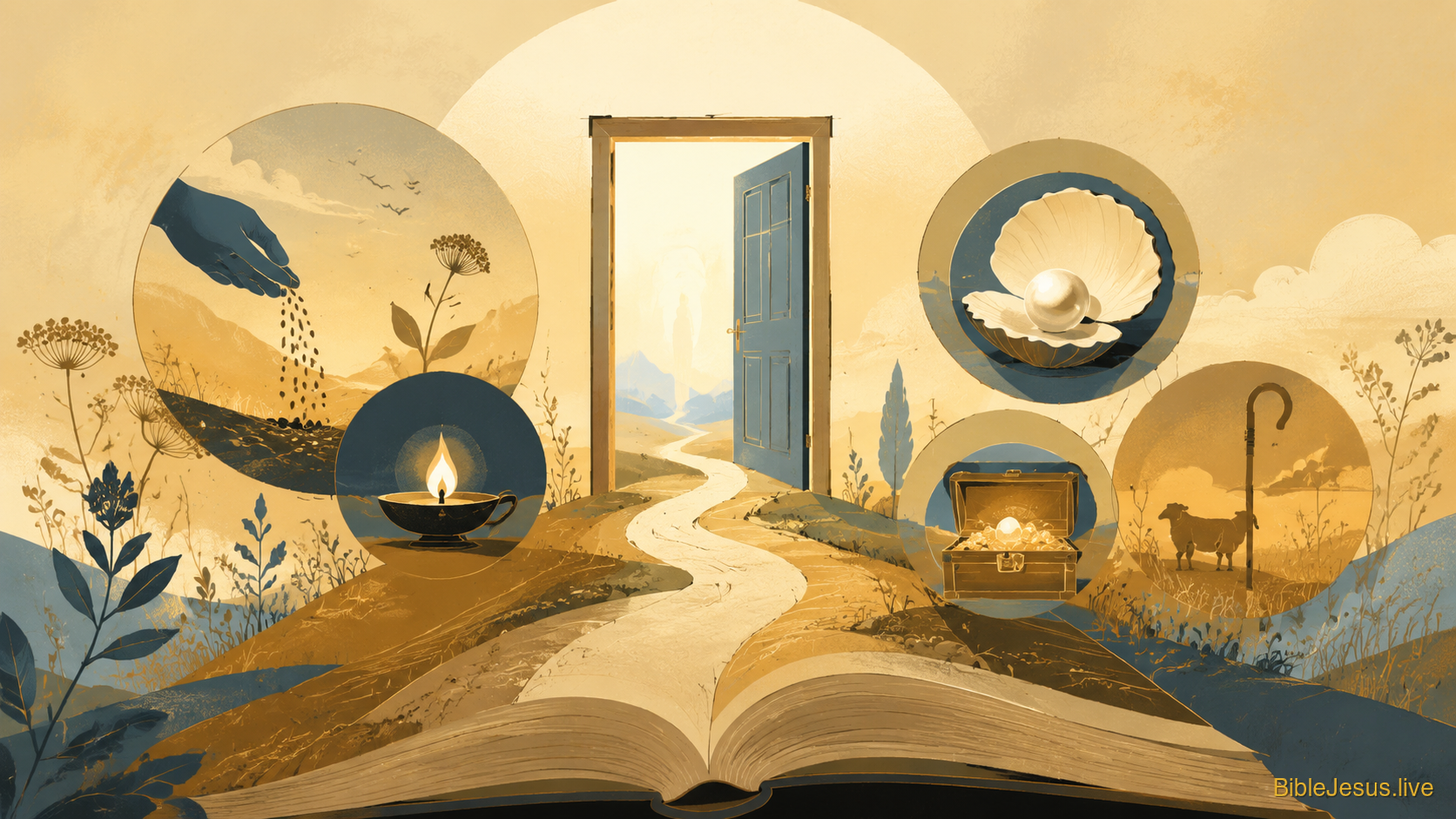
Why did you teach in parables?
Jesus: There is a question the disciples once brought to me, quiet and puzzled, after a crowd had drifted home. Matthew remembers it this way: Then the disciples came to Jesus and asked, "Why do You speak to the people in parables?"
They had watched me all afternoon, telling stories of seeds and soil, of lamps and hidden treasure, and something in them wanted a plainer word. Why not simply say the thing? Why the veil of a story? I want to sit with that question honestly, because it is not only theirs. It is yours, too, perhaps. Mark tells you something small but tender about how I lived in those days: He did not tell them anything without using a parable. But privately He explained everything to His own disciples.
Notice — the parables were my way in public. The unfolding, the quiet explaining, that happened close, in smaller rooms, among those who stayed. There is a shape to that. Truth is not always meant to arrive as a hammer. Sometimes it arrives as an invitation to come nearer. When they pressed me, I gave them a hard word — one that has troubled readers ever since. He replied, "The mystery of the kingdom of God has been given to you, but to those on the outside everything is expressed in parables,"
And in Luke's telling, I go further, borrowing the ache of the prophet Isaiah: He replied, "The knowledge of the mysteries of the kingdom of God has been given to you, but to others I speak in parables, so that, 'though seeing, they may not see; though hearing, they may not understand.'"
That sounds, at first, like I meant to hide. As if the parables were locked doors. But sit with it longer. A parable is not a lock — it is a threshold. It stands open, but you must walk through it. The story of the sower does not force itself on anyone. The pearl of great price does not shout. These little tales wait. They wait for the listener whose heart is soft enough to lean in and ask, what does that mean for me? The one who leans in — the mystery opens. The one who shrugs and walks on — the story lets them go. In Matthew I said it plainly: This is why I speak to them in parables: 'Though seeing, they do not see; though hearing, they do not hear or understand.'
This is not cruelty. It is diagnosis. There were many who came to me for spectacle, for bread, for a political revolution I would not lead. A direct sermon would have been swallowed by their own hunger for the wrong thing. But a story? A story slips past the armour. A story about a father running to meet a wayward son — that lodges somewhere the arguments cannot reach. Days later, weeks later, the parable is still working in a person who thought they had already dismissed me. So why parables? Because the kingdom of God is not a fact to be memorised. It is a country to be entered. And you do not enter a country by being handed a map — you enter by taking the road. The parables are the road. They ask something of you. They make you turn the story over in your hand, wondering which character you are, wondering why the master forgave the debt, wondering what field you have been walking past all your life without noticing the treasure buried there. Because some truths, said too directly, harden the very heart they meant to soften. But the same truth, wrapped in a story about a shepherd and a lost sheep, gets past the guards. And because — and I say this gently — I did not come to overwhelm. I came to invite. A parable respects your freedom. It offers itself and steps back. It lets you say yes, or lets you walk on. Love does not force the door. If you find that some of my stories still puzzle you, I would say: good. That is often where they begin their real work. Sit with the one that troubles you most. Ask it what it wants of you. See if, in the quiet, it does not begin to open. What parable is knocking on your door these days?
This conversation was had on BibleJesus — Talk with Jesus yourself — free on iOS ✝️